XR / VR
AgoraQuest
A Tangible VR Experience for Confronting Social Anxiety.
- Project Type
- University project, Stockholm University
- My Role
- Designer, Researcher & Developer
- Tools
- Unity · C# · Arduino · Heart Rate Sensor · Haptic Feedback · Hand Tracking
Overview
- A VR application built as a university project at Stockholm University, designed to help researchers study social anxiety by recreating social environments and pairing them with physical, tangible interfaces and live biometric data.
- Wired a heart rate sensor and a haptic feedback vibrator to the VR experience through an Arduino, so the user's physiological response was captured in real time and the simulation could respond through physical feedback. The result was a live loop between the body and the virtual environment.
- As designer, researcher, and developer, I took it through full iterative cycles: designing, building in Unity/C#, testing the hardware and software integration, and refining. It showed I can prototype experimental, sensor-driven XR end to end, even in a sensitive domain like mental health.
Introduction
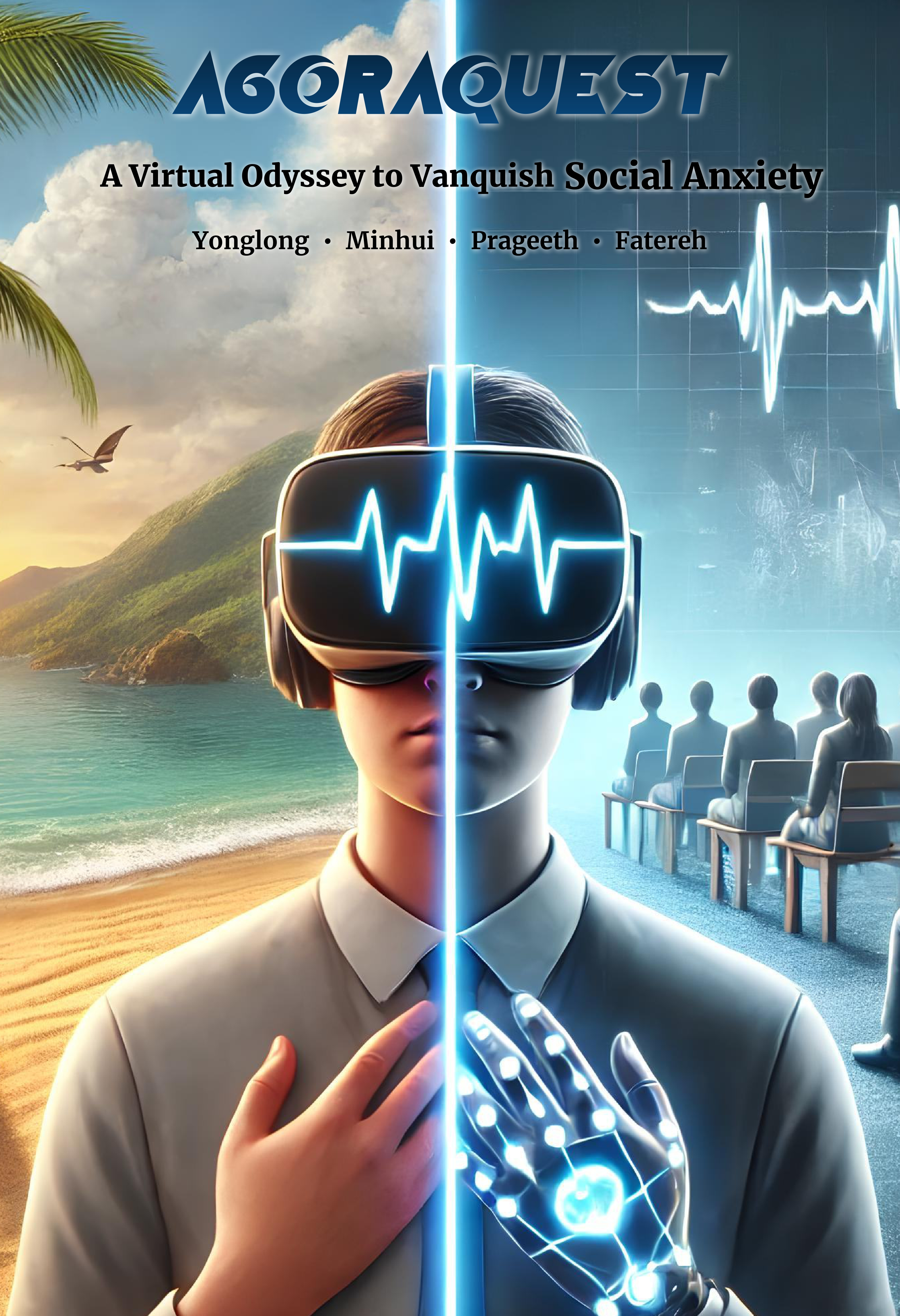
AgoraQuest is a Virtual Reality experience for practicing how to cope with social anxiety. It places the user in a virtual world crowded with people, recreating the discomfort of a busy social setting so they can face that pressure safely and at their own pace. A heart rate sensor and a physical button, wired to the headset through an Arduino, detect when the user is becoming overwhelmed, and the experience responds with guided coping practices or a calming scene. The aim is both to help people build tolerance to stressful social situations and to give others a clearer sense of what social anxiety feels like.
Design Process
The project began with literature research on the use of VR for mental health education, followed by group discussions to settle on a focus and a brainstorming session to shape the concept and name. From there the team defined the core experience: a crowded social scene, a safe way to step out of it, and a feedback loop connecting the user's real-world physiological state to the virtual environment.
Features
- A crowded virtual environment that recreates the discomfort of a busy social setting.
- A heart rate sensor and a physical button wired to the headset through an Arduino, linking the user's real-world state to the virtual experience.
- Haptic feedback through a hand-worn vibration device, mirrored by a vibration watch shown in the virtual world.
- A calming scene the user can switch to when they feel overwhelmed, to pause and recover before continuing.
- Hand-tracked interactions: poke to press buttons, ray to select scenes and menu options, and grab to handle objects.
- A virtual watch that displays the user's live heart rate during the experience.