Web App / eHealth
IQLINIQ
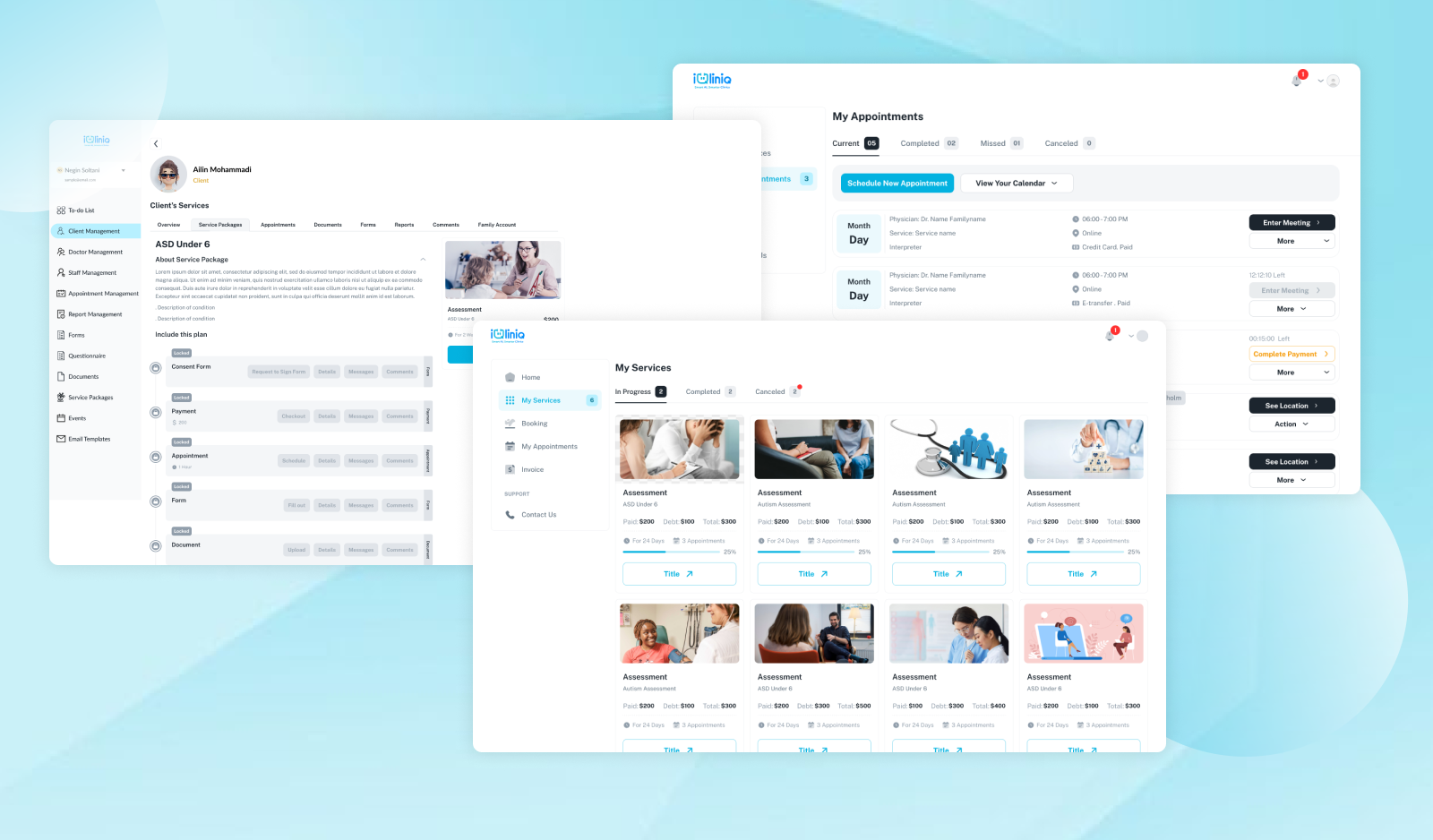
A clinic management system that streamlines treatment workflows, scheduling, reporting, and communication between patients, clinicians, and doctors.
- Timeline
- 4 months
- My Role
- UI Designer & UX Researcher
- Team
- 3 designers working on different modules
- Tools
- Figma · Minimals UI Design System · Miro · ClickUp · User Testing
Overview
- IQLINIQ is a clinic management system designed to streamline treatment workflows, scheduling, reporting, and communication between patients, clinicians, and doctors. The platform was originally built for AllBrains Clinic in Canada, then expanded into a scalable solution that can support any clinic with multi-step services.
- I focused on structuring complex flows, reducing user friction, and designing a clean, component-based interface.
Problem Space
Psychological clinics often rely on scattered tools for handling appointments, documents, progress tracking, and communication between patients, clinicians, and doctors. Key problems:
- No flexible system for multi-step treatment workflows
- Patient progress is tracked manually
- Clinicians spend too much time on documentation
- Patients struggle to understand treatment steps
- Booking systems aren't designed for clinical complexity
Research Approach
To understand real-world workflows and challenges, we used observational research inside the clinic, informal interviews with admins, clinicians, and doctors, analysis of existing workflows and documents, and comparative review of current market tools.
Key Observation Insights
Through direct observation, we noticed:
- Patient progress was tracked with spreadsheets and manual notes
- Appointments, tasks, and documents lived in separate tools
- Long-term treatment programs were difficult to follow
- Patients often missed forms or didn't know the next step
- Clinicians had no structured way to deliver follow-up tasks
Staff Interviews
Admins wanted
- A clear overview of client progress
- Easier task and service management
- Improved visibility over treatment steps
Clinicians needed
- Faster, more consistent documentation
- A structured way to deliver therapy steps
- Easy access to client history and tasks
Doctors required
- A clean schedule view
- Tools to write session notes efficiently
- Better access to service and appointment details
Competitive Analysis
We analyzed Jane App, SimplePractice, TheraNest, Mend Telehealth, and Calendly. Findings:
- Existing tools are good at booking or documentation, rarely both
- None offer a dynamic workflow builder suitable for psychological treatments
- UI patterns are often heavy and overwhelming
Design System
We built IQLINIQ using the Minimals UI Design System, a lightweight system known for its clarity and simplicity. Its clean structure made it ideal for a complex, content-heavy platform.
Benefits
- Predictable interactions
- Accessible typography and spacing
- Clean, distraction-free layouts
- Consistent components across all roles
Custom Extensions
- Modular service blocks
- Appointment cards
- Progress indicators
- Report and note elements
- Task management components
Challenges & Solutions
Challenge
Flows between patients, clinicians, and doctors were deeply intertwined.
Solution
We conducted multiple user tests and reorganized the information architecture to reduce complexity while keeping flexibility. Repeated iterations helped us refine details until the experience worked smoothly for everyone using it.
Outcomes
- Workflow became more structured and centralized
- Patients experienced more clarity and fewer mistakes
- Clinicians reduced reporting time with AI
- Admins found it easier to track service steps and tasks
- Communication between roles became more unified
Future Improvements
- Making the service builder completely component-based
- Enhancing analytics & tracking tools
- Expanding AI capabilities
- Introducing more clinic-level customization options