Mobile / Healthcare
AI Health Assistant
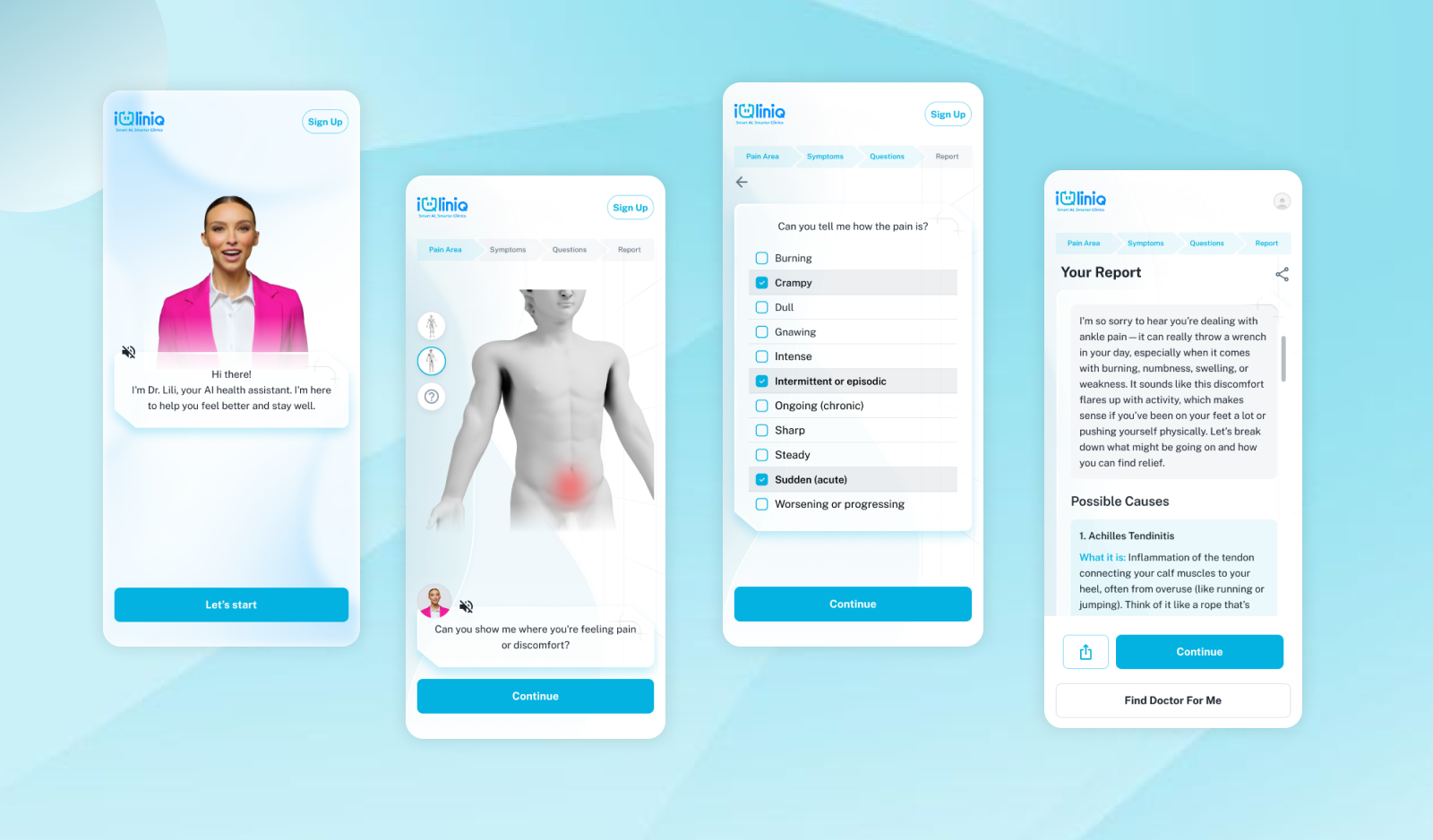
An intelligent module that helps patients understand their symptoms before visiting a clinic, through visualizations and AI-guided questions.
MobileHealthcareAI
- Timeline
- ~2 weeks
- My Role
- End-to-end design: UX flows, UI design, prototyping
- Team
- Solo
- Tools
- Figma · Miro
Overview
- The AI Health Assistant is an intelligent module that helps patients better understand their symptoms before visiting a clinic. It asks users about their symptoms through visualizations and questions, provides tailored tips and guidance using AI, and supports patient awareness and preparation before consultations. Works independently or as a module within IQLINIQ.
Problem Space
Patients often arrive at a clinic unsure how to describe what they're feeling. Generic symptom checkers feel clinical and raise anxiety instead of easing it. Key problems:
- Patients often feel uncertain about their symptoms before visiting a clinic
- Many don't know how to track or interpret symptoms effectively
- Without preparation, patients arrive unsure how to describe what they're feeling, which slows the consultation
Key Observation Insights
My research surfaced:
- In existing tools, symptom input was almost always text-heavy and clinical, assuming users already knew the medical words
- Very few tools used a conversational or visual approach, even though that's what actually lowers health anxiety
- Most were vague about whether they offered guidance or a diagnosis, and that ambiguity was where user trust broke down
Key Research Insights
- Tone and visual design are critical for reducing health anxiety
- Step-by-step AI questioning makes symptom gathering feel natural
- Clear communication about the AI's role reduces confusion and builds trust
Challenges & Solutions
Challenge
Ensuring clarity that the tool is for guidance, not treatment.
Solution
Clear communication, appropriate disclaimers, and visual design that feels supportive rather than clinical.
Challenge
Designing adaptive question flows that feel intuitive and natural.
Solution
Multiple prototypes and feedback loops with clinicians and patients ensured usability and trustworthiness.
Outcomes
- Helped patients better understand and track their symptoms
- Increased patient engagement and preparedness for clinical visits
- Seamlessly integrated into IQLINIQ while maintaining standalone flexibility
Future Improvements
- Enhanced personalization of tips based on symptom patterns
- Integration with wearable health data
- Multi-language support for broader accessibility