Mobile / Mental Health
Breeze
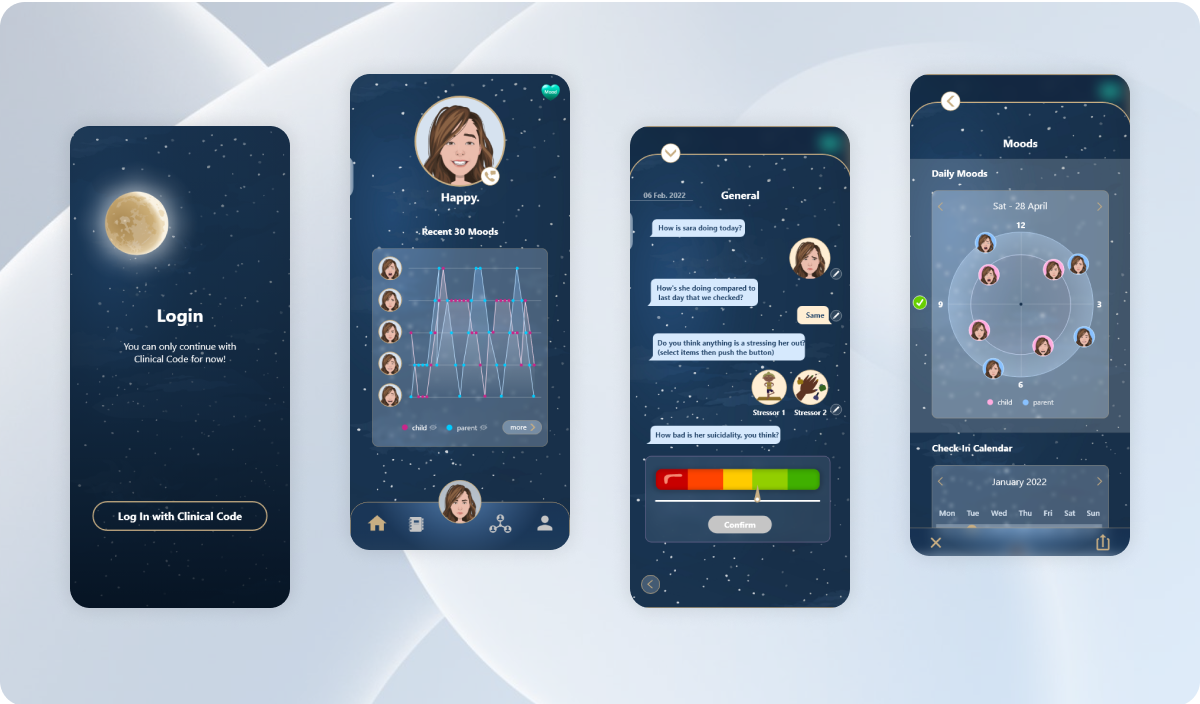
An application for children experiencing mental health challenges, connecting patients, parents, and clinicians with mood tracking and emergency support.
- Timeline
- 4 months (2 months per side)
- My Role
- Designed the doctor and parent interfaces
- Team
- Another team member designed the patient side
- Tools
- Miro · Adobe XD
Overview
- Breeze is an application designed for children experiencing suicidal thoughts or related mental health challenges. It connects patients, parents, and clinicians, offering mood tracking, personalized guidance, emergency support, and social connections. The platform aims to monitor emotional wellbeing, facilitate communication, and provide timely interventions.
- Responsibilities included UX research, user flows, wireframes, and UI design.
Problem Space
Understanding user needs across multiple stakeholder groups to build effective mood tracking and support. Key problems:
- Clinicians lacked structured insights into patient emotional trends
- Parents had limited visibility into their child's wellbeing
- Children needed safe ways to express moods and receive support
Key Observation Insights
Our research highlighted:
- Clinicians had no at-a-glance view of how a child's mood was trending, so emotional history had to be pieced together by hand
- Parents largely depended on what their child chose to share, leaving gaps exactly where visibility mattered most
- The tools already in use were fragmented across platforms, with limited real-time communication
Staff Interviews
Admins wanted
- Real-time monitoring tools
- Data analytics for trend analysis
Clinicians needed
- Structured patient mood tracking
- Communication channels with parents
- Personalized intervention tools
Doctors required
- Emergency alert systems
- Patient data history
- Chat and guidance distribution
Key Research Insights
- Need for simplified, calm interfaces for sensitive content
- Importance of multi-stakeholder communication
- Emergency support accessibility is critical
Challenges & Solutions
Challenge
Designing interfaces for sensitive mental health information.
Solution
Used calm, supportive color palettes and clear labeling to reduce anxiety while maintaining professionalism.
Challenge
Ensuring clarity while maintaining privacy and accessibility.
Solution
Structured dashboards with role-based views and encrypted communication channels.
Challenge
Creating dashboards that present complex emotional data simply.
Solution
Iterative prototyping and user feedback from clinicians ensured usability and safety.
Outcomes
- Parents can monitor their child's wellbeing in real-time
- Doctors gain actionable insights to provide timely interventions
- Communication between parents, doctors, and children is streamlined
- Children have access to support and guidance safely
Future Improvements
- Enhanced personalization for guidance and tips
- More interactive visualizations for mood trends
- Simplifying navigation for first-time parent users