XR / Mixed Reality
SolarXR
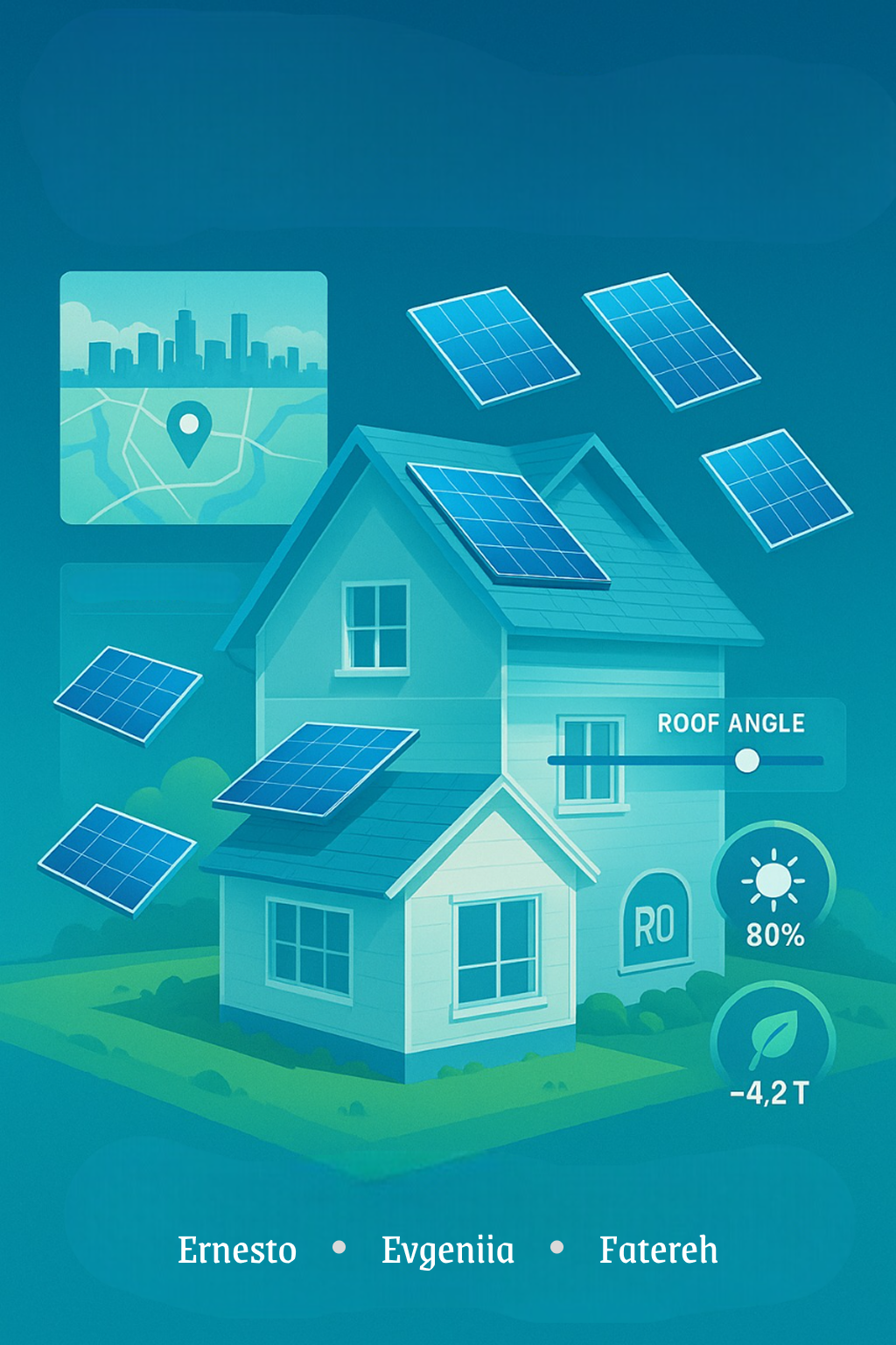
Explore the benefits of solar panels with real-time statistics for your house, in Mixed Reality.
- Project Type
- University project, Stockholm University
- My Role
- Designer, Researcher & Developer
- Team
- Evgeniia Dolgikh, Fatereh Tondro, Ernesto Galarza
- Tools
- Unity · C# · Photon · Meta Quest · Meta XR SDK · PVGIS
Overview
- A collaborative Mixed Reality tool for Meta Quest, built as a university project at Stockholm University, that overlays live 3D data onto a physical model of a house, so multiple users can explore and optimize solar energy together in real time.
- Merged a tangible physical model with digital data visualization and real-time multi-user networking (Photon), so several people in headsets could see and interact with the same simulation at once. It's one shared space, part physical and part digital.
- Brought together Unity/C# development, 3D interaction design, and collaborative XR to turn abstract technical data into something spatial, hands-on, and multiplayer.
Introduction
SolarXR is a Mixed Reality project exploring the efficiency and benefits of solar panels, tailored specifically to your location. It lets users see, in real time, what solar energy could mean for their own home rather than relying on abstract numbers.
Design Process
The design process started with a brainstorming session where each of us focused on ideas for an immersive experience, following the Digital Twin concept, which meant building a living virtual counterpart of a real house that users could interact with directly.
Digital Twin with Solar Panels
We built a Digital Twin of a residential house in Unity. This virtual representation lets users interactively explore the installation and performance of solar panels under different conditions, such as roof tilt angles and panel quantities.
The Digital Twin is enriched with real-world data from the Photovoltaic Geographical Information System (PVGIS), provided by the European Commission's Joint Research Centre (JRC). By integrating this reliable dataset, the system gives realistic estimations of solar energy production based on geographical location, roof orientation, and other environmental parameters. It also supports collaborative adjustments through Photon for multi-user experiences.
Architecture
To understand how much energy solar panels produce depending on their installation angle, we developed a web service powered by PVGIS data. Photon then layers real-time networking on top, so the entire interaction becomes collaborative and shared across everyone in the session.
User Testing
The demo version of the experience was presented to and tested by several people, who gave us valuable feedback. Based on it, we refined how the experience is presented and made minor changes to the gameplay and UI elements, such as the menu, to make the overall flow smoother for users.
Features
SolarXR includes the following features:
- A virtual house where users can control their surroundings, adjusting sound level, light flickering, and the movement of people.
- A configuration panel that guides users to a Safe Space if they feel uncomfortable and want to pause the experience.
- An interactive map with three city buttons, used to select the reference location for displaying the solar energy produced there.